Quick links
Our pitch deck:
https://docs.google.com/presentation/d/1q9Z9zoHGjeTZyJZ7jMe7MB3bZpb-hHNlURe0AIITqm4/edit?usp=sharing
Backend repo:
https://github.com/tulasikarnati/git-good.git
Figma prototype:
Team Roles and Contributions
Tia
Tia was in charge of the frontend.
karnati
Karnati was in charge of developing the backend notification system.
Farah
Farah was in charge of product development and UX UI design.
the spark
Framing the Problem
The IT and tech sector is estimated to consume 7% of global electricity. If it were a country, it would be the 3rd largest global consumer, behind only the USA and China. And the industry is growing exponentially. The number of software engineers will reach 28.7 million worldwide by the end of 2024, the population of software personnel is expected to record a growth rate of 22% by 2029. Software principles like SOLID and DRY are well-taught in bootcamps and well known but green software principles are barely mentioned.
With this influx of new software engineers, how can we instill green software engineering practices from the very beginning?
One key concept in green software engineering principles is carbon intensity. How much renewable energy sources you're drawing on depends on your location, time of the day and weather conditions. When your local electricity is using more renewable sources, carbon intensity is low. When it's drawing more on fossil fuels, carbon intensity is high. Carbon awareness means doing more when energy is cleaner and doing less when energy is dirty.
Idea Explanation
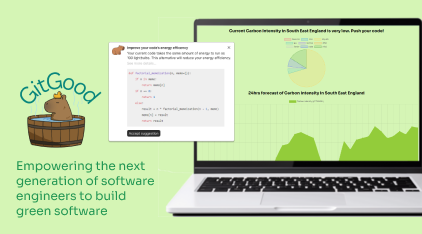
Our idea to get tech newbies started in thinking about green software is GitGood, tools that would embed green software principles in their practice.
We took a case that many tech newbies are familiar pushing their projects to Github. A user would enter their postcode and frequency of their notification. Our platform would then notify the user via email when is the ideal time to push their projects to Github when the electricity is running on more clean energy sources.
under the hood
Tech Stack
Our solution draws from existing data from the National Grid API which shows the carbon intensity of electricity in a given location on the national power grid. We used the following technologies in our codebase:
Project Technology Stack
The project codebase was composed with the following list of technologies:
Language | % of Codebase |
|---|---|
JavaScript | 78.3 |
CSS | 11 |
HTML | 10.7 |
since then
Next Steps
Our next step would be to embedd GitGood directly to the user's IDE such as VScode. This would trigger a real-time trigger to suggest the ideal time for the user to push their project, exactly when the devoloper would be considering to push their project.
We would also add features that tackle other green software principles like code efficency. Our embedded tool would provide suggestions to improve code efficency communicated in undertandable real-life comparisons.
Business and Monetisation
Our tool isn't only relevant for newbies but can be scaled to companies as well. With more organisations pledging to science-based targets and net-zero, they will need tools for their development team to contribute to this goal as well. The global green technology and sustainability market size was valued at USD 16.48 billion in 2023. The market is projected to grow from USD 19.76 billion in 2024 to USD 89.97 billion by 2032. We would pitch a business package for companies that could then support our work for people getting into tech.
Sources
- Climate crisis and the technology sector | CI&T (ciandt.com)
- Green Technology and Sustainability Market Size | Report 2032
- 40+ Software Development Statistics 2024 That Will Stun You (techreport.com)
- Welcome | Learn Green Software